The restless, relentless, mechanical and thunderous beat goes on as the left hand begins to pound the piano. The right hand follows suite and thus begins one of Sergei Rachmaninoff’s most well known compositions- his Prelude in G Minor from Études-Tableaux Op. 39 No. 6.
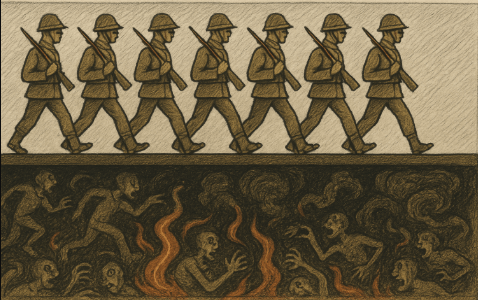
While Rachmaninoff’s Prelude in G Minor seems to be glorious and triumphant in nature, as the piece goes on it gives us the feeling of something pretending to be in control. Underneath the pretense lies something that is spiraling out of control into a state of collapse. Much like the Indian Economy since 2014.
In the beginning of the piece till here what we find is a fast, brutal storm like march. What we should primarily focus on here is the left hand Ostinato which can be related to India’s obsession over its GDP of 4.3 Trillion Dollars which surpassed Japan to become the fourth largest economy in the world. With a GDP growth rate of 7%, India is one of the World’s largest growing economies today. The ostinado in this prelude is like a chase- India’s chase to gaining a high status in global affairs, India’s great achievements (especially since 2014) – yet it all seems empty. The GDP, lunar landings, global summits such as the G20 are given so much importance that we safely ignore all other aspects of our nation.
And that is highlighted throughout the rest of the course of this Prelude. Rachmaninoff highlights how all the propaganda of glory is all unnatural and how from here it actually shows us the true picture. This section shows us a melancholic and almost broken introspective. The middle section of the piece could be compared to India’s public collapse. The right hand in this part especially screams maniac unpredictable melodies in sharp contrast to the march like Ostinado before. The jolts and the rising tension in the right hand here are perhaps the clearest description of the ‘real India’ plagued by unemployment, crumbling healthcare, farmer suicides and education inequality. The government’s left hand pounds its march—but the people scream in the right hand, unheard.
The dissonance and tonal ambiguity that the left hand desperately tries to mask from here shows us how hard our government tries to conceal vital information from the public. Let us look at this 2019 article from the Times of India which shows us how the government did not release the 2017-18 consumer expenditure survey due to “data quality issues”. This was after a news report survey had shown that rural area consumption had slumped the most in the past 4 decades in 2017.

While India is so focussed on her GDP, we hardly question the other indexes of measuring a country’s growth such as the unemployment and poverty rates. But, what is our unemployment and poverty rate?
(Below: The Business Standard)

(Below: The Indian Express)


Well, that would be a great question indeed. The 2017-18 poverty reports have been delayed while the Fudging poverty data has not seen a single official release since the 2011.
The only reason a government, or any higher authority would conceal vital information such as this requires no explanation. To tarnish the picture perfect image of a country is never on any governing body’s to do list in our world today, more so in our country. What used to be referred to as information before has today become a form of ‘threat’.
Rachmaninoff’s sudden mood swings in his Prelude in G Minor; shifting from loud to soft, brutal to brittle parallels the policy whiplash that destroys investor confidence and public trust in India. Be it demonetization or the sudden farm laws of 2020- one thing all these policies prove is that the common people of our country are vulnerable.
For instance the 3 Farm Laws of 2020 encouraged private trade by allowing farmers to sell outside the APMC markets, legalised contractual farming which allowed big corporations to exploit small farmers and removed cereals, pulses, onions and potatoes from the essential commodities list- making companies free to hoard goods, causing price hikes and hurting consumers.
It took a year of relentless protests and unrest by the farmers for those laws to be repealed next year in November 2021, however the fact remains. The government is against the common people of our country.
The prelude has a very quick, subdued and fading end. Whilst powerful authoritarian institutions love to carry on the facade, reality cannot be hidden forever. And when reality comes crashing in, the left hand Ostinado fails to keep the right hand, or the voices of the people, in check. It all comes tumbling down all too sudden after which the charade finally ends.
As the rich grow richer, the middle class sinks, the Gini coefficient worsens and the working class gets even more disempowered, we must ask ourselves: how far are we from those final moments—when the relentless ostinato finally breaks, the government loses its grip on data and narrative, and, like in Rachmaninoff’s closing bars, the illusion of control collapses into silence—and the people, finally, are heard.

Leave a comment