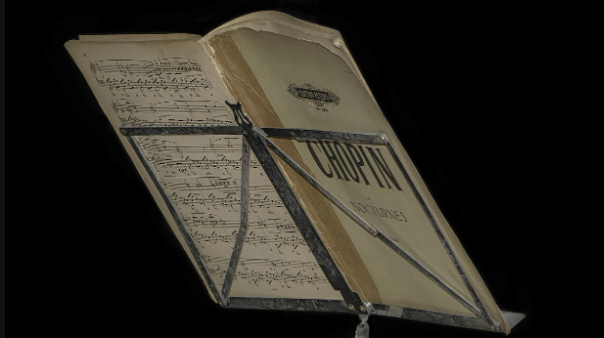
Poems and prose are constrained by the boundary of words, limited to the alphabet’s small alphabet of symbols. Paintings are fenced in by pigment and canvas, their emotion frozen by the moment of their completion. But music breathes as it moves through time in an unfixed, intangible and often an inexplicable manner- speaking directly to the heart what can’t be said out aloud. Music, the purest edge of human expression, allows grief, memory, pain, happiness, love- all to be expressed at the same time; and no composer understood it better than Frederic Chopin.
Chopin’s compositions changed the way we look at music. The article will analyze the reasons behind the uniqueness of Chopin’s music and the factors involved in it.
Chopin was the epitome of Romanticism. In sharp contrast to all other Composers before him, his music had a much more inward gaze- deeply personal and reflecting his own emotions and intimate expressions of the soul rather than the society at large. Mozart’s compositions for instance had a lot of perfectionism, striving to sound what one might say ‘correct’ with all the rules of harmonization applying and the music being rather simple yet grand for the Aristocracy to appreciate. Chopin however, appeased no one and composed what he wanted to compose.
His personal life had a huge impact on his musical expression. He was born in 1810 near Warsaw and he grew up amidst Polish folk traditions. Thus Chopin’s Mazurkas and Polonaises echo Polish Nationalism and rural dance idioms above all others. If we look at his Mazurka in D Major Opus 33 No. 2, we find a distinct separation between the rustic Polish folk dance music and the milder and more sophisticated version for the Nobility- this particular Mazurka was very crucial for bringing the essence of Polish music to the higher classes through the Piano and popularising it. His early childhood and Polish roots also influenced much of his Polonaise works such as the Militaire Polonaise, Opus 40 No. 1, a proud, bold rhythm reflecting patriotic fervor.
Chopin’s music post 1830 shows a different colour. Just before the November Uprising in Poland which was an armed rebellion against the Russian Rule in Poland, Chopin left his country for Paris; never returning back. The deep nostalgia and alienation he faced as a result of this was infused in most of his works from then on. For instance his Mazurka in A minor, Op. 17 No. 4 is filled with mournful harmonies which evoke deep sorrow and a sense of longing. Arthur Rubinstein – Chopin Mazurka, Op. 17 No. 4.
This sense of exile became not just a condition of his life, but the very core of his artistic identity. Though physically present in the salons of Paris, Chopin’s heart remained rooted in the landscapes and rhythms of a lost homeland. Even in works without overt national themes, such as the Prelude in E minor, Op. 28 No. 4, one hears the quiet weight of distance and resignation. Exile, for Chopin, was not only political but emotional—his music mourns a country he could no longer touch and a life he could never reclaim.
Chopin’s lifelong struggle with ill health— then diagnosed with tuberculosis imbued his music with a profound delicacy and introspection. Physically frail and emotionally sensitive, he avoided large concert halls and instead composed for the intimacy of salons and private gatherings. This physical vulnerability shaped not just his performance style but the very texture of his compositions. His Nocturnes shimmer with a fragile lyricism, often hovering on the edge of silence, as if they fear the weight of the world. For Chopin, illness was not merely a condition but an atmosphere that lay a blanket over every note.
Equally formative was Chopin’s turbulent relationship with the writer George Sand (Aurore Dupin), which spanned nearly a decade. Their time together was marked by both creative fertility and personal strain. During this period, Chopin composed some of his most emotionally expansive works, including the Prelude in D-flat major, better known as the Raindrop Prelude, Op. 28 No. 15, which shifts between gentle lyricism and stormy unrest—mirroring the instability of their partnership. As the relationship deteriorated, so too did the tone of his music. Later works like the Ballade No. 4 in F minor, Op. 52 reveal a darker, more introspective complexity, suggesting emotional exhaustion and disillusionment.
However, to say that his personal life was the only impact on his music would be incomplete. The influence of economics and class played an important role especially post 1830 when he shifted to Paris. Chopin’s primary income was through teaching wealthy students and performing at private salons. Thus a lot of his music was tailored for intimate, refined tastes of upper-class patrons. The best examples would be his Waltzes, let’s take Op. 64 No. 2 for instance. They were elegant and sophisticated, meant for parlours instead of concert halls, since his fragile health and elite positioning restrained him from performing much there.
Chopin’s music doesn’t try to speak for a crowd, a nation, or a cause. It speaks only for himself. It’s the sound of someone quietly working through exile, heartbreak, sickness, and memory alone, at a piano. He taught us to stop striving for perfection and found music as a tool to express the imperfection that everyone wished to hide. Perhaps that is what makes Chopin one of the greatest composers of all time.


Leave a comment